
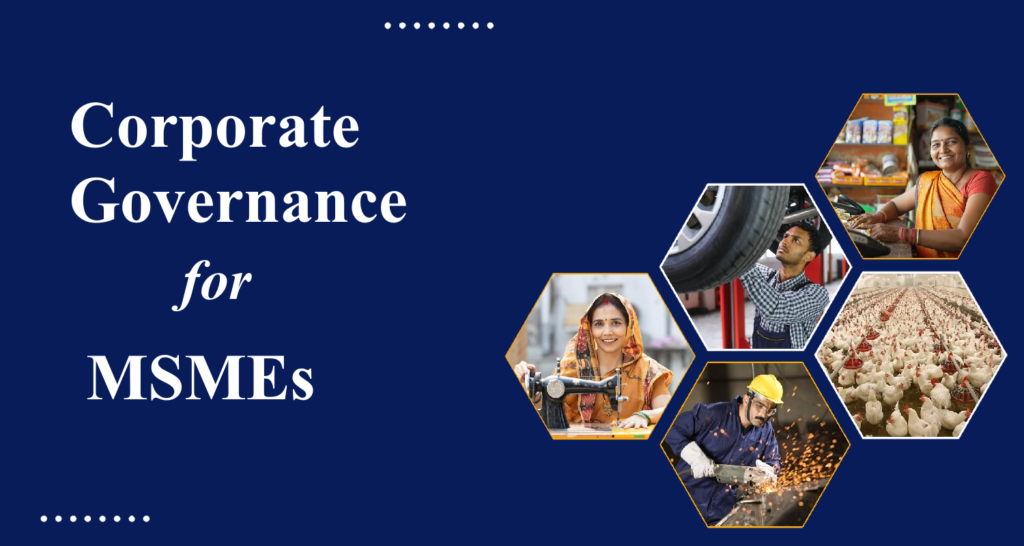
When I delivered an expert session on Corporate Governance for MSMEs recently, the most common reaction from entrepreneurs was predictable: “This is for Tatas and Infosys, not for us.”
That perception that governance is only for large or listed companies is not just wrong. It’s dangerous.
Over nearly four decades spanning Public Sector Enterprises, Listed Banks, Telecom MNCs, and Family-run Manufacturing Companies, I’ve witnessed a consistent truth: most business failures are not market failures; they are governance failures.
And nowhere is this more visible or more devastating than in India’s 63 million MSMEs.
The MSME Governance Gap
India’s MSMEs contribute 30% to GDP, 45% to exports, and employ over 110 million people, second largest after agriculture. They are the backbone of our economy. Yet less than 15% have access to formal institutional credit, and a tragically small fraction survive beyond the first generation.
Why? The gap is governance-driven. As MSMEs integrate into global supply chains, governance expectations are being pushed down the value chain. European buyers demand labour compliance. Automobile OEMs require environmental certifications. Banks scrutinize fund utilization patterns more rigorously than ever before.
Governance is no longer optional. It has become a condition for market participation.
Building Governance Structure
Governance is not bureaucracy. It’s clarity, accountability, and discipline built on core four universal pillars viz., Accountability, Transparency, Fairness, and Responsibility.
For MSMEs, governance means:
- Clear role separation: Ownership (board) distinct from management (CEO), even if the same person wears both hats.
- Decision documentation: Major decisions, capital expenditure, related party transactions, management appointments, documented.
- Independent oversight: An advisory board with 2-3 external experts who provide genuine counsel, not ceremonial presence.
While Indian law provides robust frameworks: the Companies Act, 2013; SEBI LODR Regulations (as a benchmark); and sector-specific requirements, the challenge is adapting principles proportionally according to size and risk involved.
The 3-S test working definition I’ve found most useful for MSMEs:
“The system by which a business is directed, controlled, and held accountable—in a manner that allows it to survive scrutiny, stress, and succession.”
Scrutiny from regulators.
Stress from market shocks.
Succession beyond the founder.
That’s the governance test.
Managing Stakeholder Relationships
Most MSME promoters answer “shareholders and bankers” when asked about stakeholders. That’s incomplete.
Stakeholders include employees, vendors, customers, regulators, and communities. Post-India’s NPA crisis, banks evaluate governance quality, not just balance sheets. I’ve seen identical MSMEs receive vastly different credit terms based purely on governance perception.
The reality: India’s MSMEs owe ₹7 lakh crore in delayed vendor payments, disrupting entire supply chains. Construction MSMEs ignore labour welfare and face project stoppages. Textile exporters fail compliance and lose European contracts.
Most MSME crisis start with ignored stakeholders. Stakeholder accountability isn’t altruism, it’s pragmatic risk management.
Risk Management
For MSMEs, the biggest risks aren’t market-related. They’re governance risks:
- Financial misreporting to meet bank covenants.
- Fund diversion to related parties.
- Weak documentation with no audit trail.
- Regulatory non-compliance.
Risk management doesn’t require sophistication—just disciplined thinking:
- Identify: What could go wrong?
- Monitor: Who owns each risk? Early warnings?
- Mitigate: Controls, contingencies, accountability.
Practical tools: Risk registers (simple Excel tracking), internal controls (segregation of duties, dual approvals), periodic reviews (quarterly check-ins), external advisors (fresh, unbiased perspectives).
An auto-ancillary MSME I advised discovered through a simple risk register that they had no backup supplier for a critical component. One disruption could have halted production. The register made the invisible visible and fixable.
Governance is about seeing risks before they become crisis.
Overcoming Governance Challenges
Let’s be honest. Governance in MSMEs faces real challenges:
- Structural barriers: Informality (decisions over chai), cost constraints, resistance to change, lack of expertise.
- Mindset barriers: The biggest obstacle is the promoter’s mindset, fear of losing control, overconfidence, mixing family and business, emotional decision-making.
The way forward? Proportional, phased governance.
- Start small: Risk register, quarterly board reviews, basic Code of Conduct, delegation of authority.
- Scale up: Advisory board, internal controls, strengthen MIS.
- Build culture: If promoters model integrity, organizations follow.
- Leverage external advisors: Learn from experienced practitioners and those who’ve seen good governance in action.
Governance is a journey, not a destination.
Governance as Strategic Enabler
Governance is not a cost center. It’s a growth enabler. Governance delivers tangible benefits:
- Credibility: Banks trust you, customers choose you, employees stay.
- Capital: Lower cost of capital, higher credit limits, better valuations.
- Continuity: Business outlives founder, succession smooth, stakeholder relationships endure.
Here’s a simple formula I share with every MSME: Legal Compliance + Ethical Conduct = Long-term Sustainability.
Law protects today. Ethics protect tomorrow.
Final Thoughts
In India, businesses don’t collapse because markets fail them. They collapse because trust fails them. Trust from banks, customers, employees, vendors, regulators. Once broken, nearly impossible to restore.Strong governance doesn’t slow growth, it sustains it. For MSMEs navigating ESG pressures, supply chain scrutiny, and regulatory tightening, governance is a strategic imperative. The businesses that survive are those that deserve to survive, because they’ve built trust with everyone who depends on their success.